
NEWS
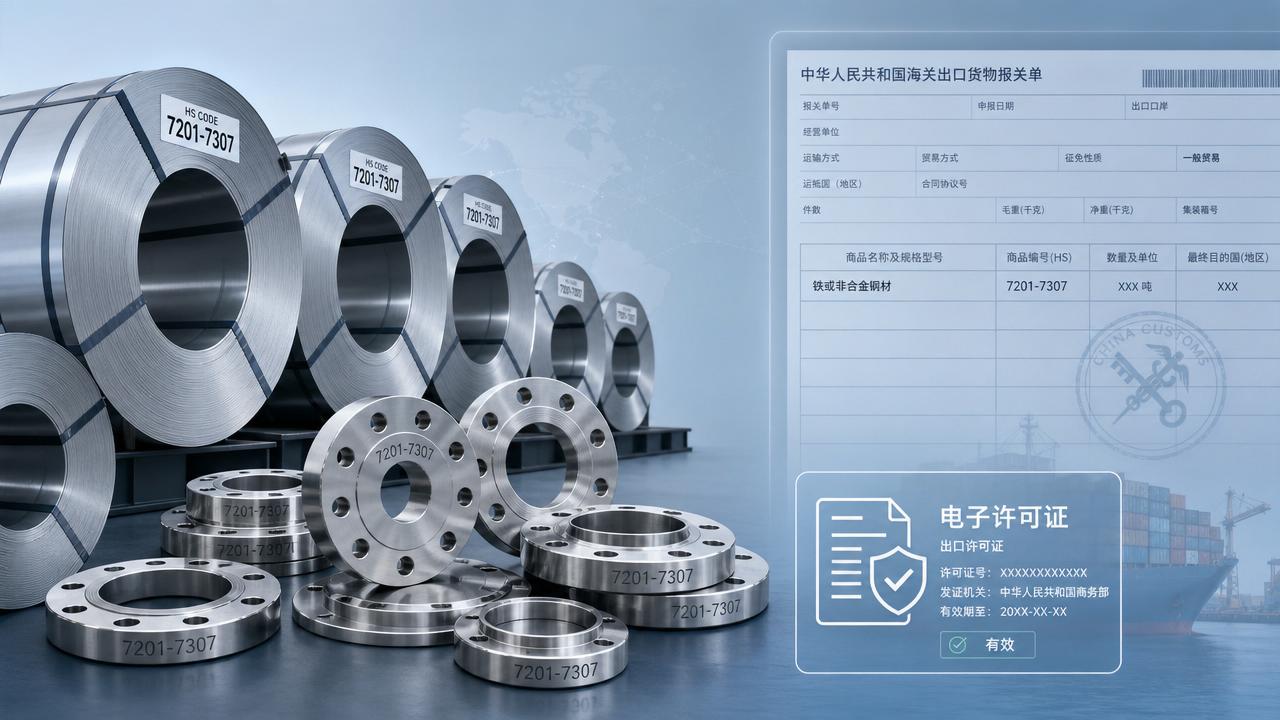
Starting January 1, 2026, China’s Ministry of Commerce (MOFCOM) and General Administration of Customs (GACC) will implement an export license regime for steel products under HS codes 7201–7307—including steel pipes, plates, rails, and flanges. This regulatory shift directly affects international buyers, trading companies, and downstream manufacturers reliant on Chinese steel imports, particularly in construction, infrastructure, energy, and industrial equipment sectors.
Event Overview
Effective January 1, 2026, export licenses are mandatory for all shipments of steel products classified under HS codes 7201 to 7307. Exporters must apply for licenses using verified export contracts and quality inspection certificates issued by the manufacturing enterprises. The policy is officially administered by MOFCOM and GACC, with no transitional grace period announced.
Industries Affected
Direct Trading Enterprises
Trading firms acting as exporters or intermediaries between Chinese mills and overseas buyers face immediate operational impact. License application adds a mandatory pre-shipment step, introducing potential delays in documentation processing and customs clearance timelines. Without valid licenses, shipments may be detained or rejected at Chinese ports.
Raw Material Procurement Entities
Buyers sourcing steel for fabrication, project execution, or inventory replenishment—especially those operating under fixed delivery schedules (e.g., EPC contractors, OEMs)—must now verify supplier license eligibility before contract finalization. Unlicensed suppliers risk order cancellation or unplanned rescheduling, affecting procurement planning and cost forecasting.
Downstream Manufacturing Firms
Manufacturers integrating imported Chinese steel into finished goods (e.g., pressure vessel fabricators, railcar assemblers, structural steel fabricators) may experience extended lead times if their upstream suppliers lack timely license access. This could disrupt production sequencing and inventory turnover, especially where steel inputs represent critical path items.
Distribution & Supply Chain Service Providers
Logistics providers, freight forwarders, and customs brokers supporting steel exports must update internal compliance checklists to include license verification prior to booking or document submission. Failure to confirm license status may result in shipment hold-ups, increased demurrage costs, or service liability exposure.
Key Focus Areas and Practical Responses
Monitor official guidance and implementation updates
Observe MOFCOM and GACC announcements for clarifications on license application procedures, processing timelines, eligible enterprise categories, and any exemptions. As this is a newly introduced requirement, early-stage administrative interpretations may evolve in Q1 2026.
Verify license eligibility before purchase commitments
Require written confirmation from Chinese suppliers that they hold—or are authorized to obtain—valid export licenses for the specific product category and HS code. Cross-check supplier registration status via publicly accessible MOFCOM licensing platforms where available.
Distinguish policy signal from operational readiness
Recognize that formal issuance of the regulation does not guarantee uniform enforcement readiness across all Chinese ports or local customs offices. Some regional authorities may adopt phased rollout or require additional internal training—making early engagement with licensed suppliers advisable over last-minute procurement.
Adjust procurement timelines and contingency planning
Add minimum 5–7 business days buffer to order-to-shipment cycles to accommodate license application and approval. Where feasible, diversify sourcing to include non-Chinese suppliers for time-sensitive projects, without assuming automatic substitution feasibility due to technical or certification constraints.
Editorial Perspective / Industry Observation
Observably, this measure signals a tightening of export control mechanisms—not primarily for trade volume restriction, but for enhanced traceability and quality accountability in strategic metal exports. Analysis shows it reflects broader trends in export governance: shifting from quota-based management toward compliance-driven oversight. It is currently more a procedural signal than an immediate market disruption; however, its long-term effect depends on how consistently and transparently licensing is administered across regions and product subcategories. The industry should treat this as an ongoing compliance benchmark—not a one-time adjustment.
Conclusion: This licensing requirement introduces a new layer of procedural due diligence for stakeholders engaged in Chinese steel trade. It does not alter tariff treatment or market access per se, but elevates documentation rigor and supplier vetting as core operational prerequisites. Currently, it is best understood as a structural recalibration of export governance—one that prioritizes regulatory transparency and supply chain traceability over volume control.
Source Information:
• Ministry of Commerce of the People’s Republic of China (MOFCOM)
• General Administration of Customs of the People’s Republic of China (GACC)
Note: Implementation details—including average license processing duration, regional variance in enforcement, and eligibility criteria for trading vs. manufacturing exporters—remain subject to ongoing observation and official clarification.
NEWS NAVIGATION
CONTACT US