
NEWS

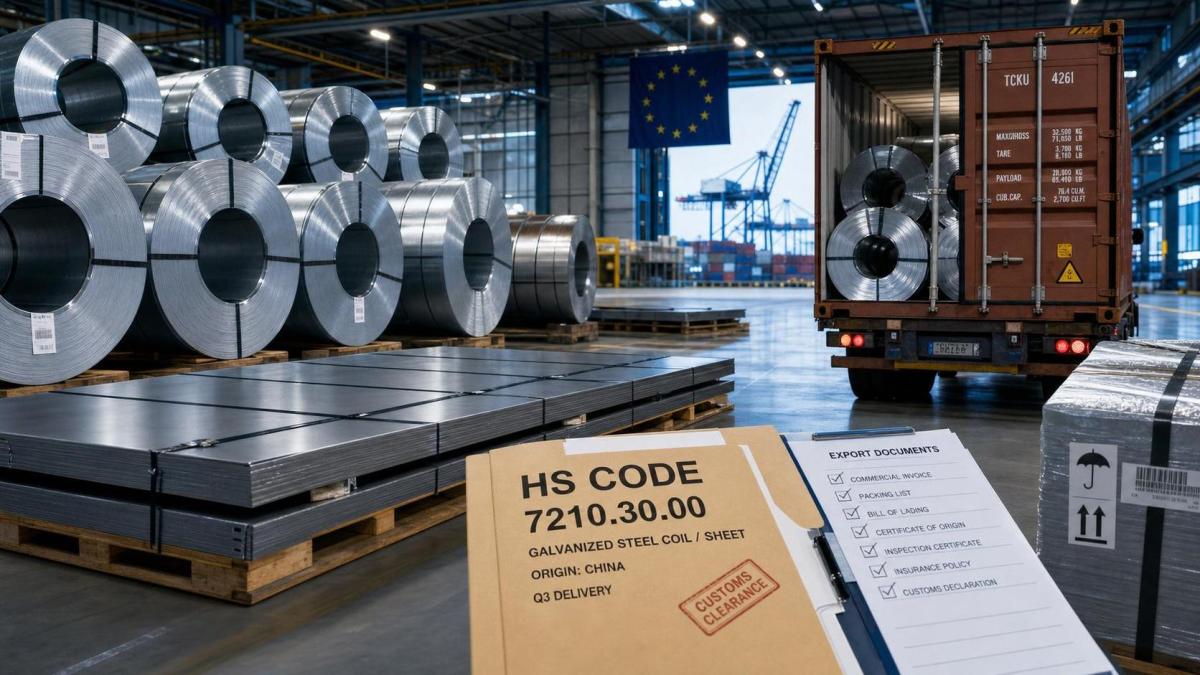
On June 22, 2026, the European Commission formally opened an anti-dumping investigation into galvanized steel sheet originating in China under HS 7210 and 7212. For companies involved in steel trade, distribution, customs handling, and downstream purchasing, the key issue is not only the launch of the case itself, but also the timing: a preliminary ruling is expected before the end of September 2026 and could affect third-quarter delivery schedules, clearance arrangements, and documentation requirements across Europe-bound business.
What Has Been Confirmed So Far
According to the information provided, the investigation was officially announced by the European Commission on June 22, 2026. The products covered are galvanized steel sheet from China classified under HS 7210 and HS 7212. The products involved account for about 3.2% of China’s total steel exports.
The investigation period runs from October 2025 to March 2026. A preliminary decision is expected by the end of September 2026. The summary provided states that provisional duties may be imposed at that stage, which could in turn affect third-quarter order delivery and customs clearance arrangements.
The same summary also indicates that the move has already prompted European distributors to reassess procurement cycles and compliance documentation requirements.
Where the Pressure May Appear First
Export transactions may face timing and cost uncertainty
From an industry perspective, direct trading companies are likely to focus first on contract timing, shipment planning, and exposure to possible provisional measures. If a preliminary ruling arrives near the end of the third quarter, the practical pressure point is whether booked cargo, in-transit cargo, or pending customs clearance could face changed duty expectations or revised document scrutiny.
European distributors may adjust purchasing windows
Observably, distributors in Europe are already reassessing procurement cycles. This matters because buying decisions may shift earlier, slow down, or become more conditional while the investigation is still ongoing. The impact is likely to be felt in ordering cadence, inventory planning, and supplier communication rather than only in headline pricing.
Supply chain service providers may see heavier compliance work
Customs brokers, logistics coordinators, and related service providers may be affected through stricter attention to product classification, origin records, and supporting documents. What deserves closer attention is that compliance preparation can become a business bottleneck even before any provisional duty is confirmed.
Downstream buyers may review delivery commitments
Manufacturers and procurement teams using galvanized steel sheet may not be the direct target of the investigation, but they can still be affected through delivery risk and clearance uncertainty. Their main concern is likely to center on whether third-quarter supply commitments remain aligned with import procedures and lead times.
What Companies Should Watch Now
Follow the wording of upcoming official steps
Analysis shows that companies should distinguish between the opening of an investigation and the content of later decisions. The immediate task is to monitor how future official statements define product scope, process timing, and the preliminary ruling framework rather than assuming a final outcome from the opening notice alone.
Check product classification and case exposure
Businesses dealing in galvanized steel sheet under HS 7210 and HS 7212 should review whether their products and shipments fall within the covered scope described in the provided summary. This is especially relevant for orders that may overlap with the expected preliminary decision timeline.
Prepare documentation before clearance pressure rises
Since European distributors are already reassessing compliance documentation requirements, exporters, importers, and service partners should pay closer attention to origin-related records, product descriptions, and shipment paperwork. The practical issue is not only formal compliance, but whether documentation can support smooth customs handling if scrutiny increases.
Align customer communication with shipment schedules
What deserves closer attention is the gap between policy process and operational execution. Companies with third-quarter deliveries should review customer communication, shipment timing, and contingency planning so that expectations on lead time and clearance risk are addressed early rather than after cargo movement has begun.
Why This Still Requires Ongoing Monitoring
This article’s assessment is analytical rather than factual: at this stage, the development is better understood as an active trade remedy process with possible operational consequences, not as a confirmed final trade outcome. The investigation has a defined timetable, and the expected preliminary decision by late September 2026 gives the market a near-term point to watch.
Analysis shows that the importance of this development lies in its effect on business preparation. Even without a final result yet, distributors and supply chain participants are already adjusting procurement and compliance behavior. That makes the case relevant not only as a policy signal, but also as a near-term operational issue for Q3 planning.
How to Read the Current Signal
At present, it is more appropriate to understand this development as a short-term trade and delivery risk signal with broader implications still subject to further official steps. The confirmed facts support close attention to timing, documentation, and order execution, but they do not yet support a definitive conclusion on the final duty outcome.
For the industry, the practical significance lies in preparedness. The combination of an active investigation, a late-September preliminary ruling window, and possible effects on delivery and customs handling means this is a case that warrants continued monitoring rather than premature conclusions.
Basis of This Article
This article is based on the user-provided news title, event date, and event summary concerning the European Commission’s anti-dumping investigation into Chinese galvanized steel sheet. The summary provided forms the factual basis of the article.
For developments of this type, commonly relevant source categories may include official government or regulator announcements, company disclosures, industry association updates, authoritative media coverage, and trade or standards-related documentation. A specific official source link was not provided in the input, so the exact source document should continue to be verified. The next points to monitor are any further official wording, the preliminary ruling expected before the end of September 2026, and whether temporary measures alter delivery or clearance arrangements.
NEWS NAVIGATION
CONTACT US