
NEWS

On July 1, 2026, updated transitional reporting requirements under the EU Carbon Border Adjustment Mechanism (CBAM) become mandatory for Chinese exporters of steel products shipped to the EU. The change is worth close industry attention because it does not only add a filing obligation through the CBAM portal, but also links export compliance more directly with carbon data preparation, third-party verification, upstream sourcing records, pricing discussions, and shipment planning across the steel trade chain.
What the updated filing requirement confirms
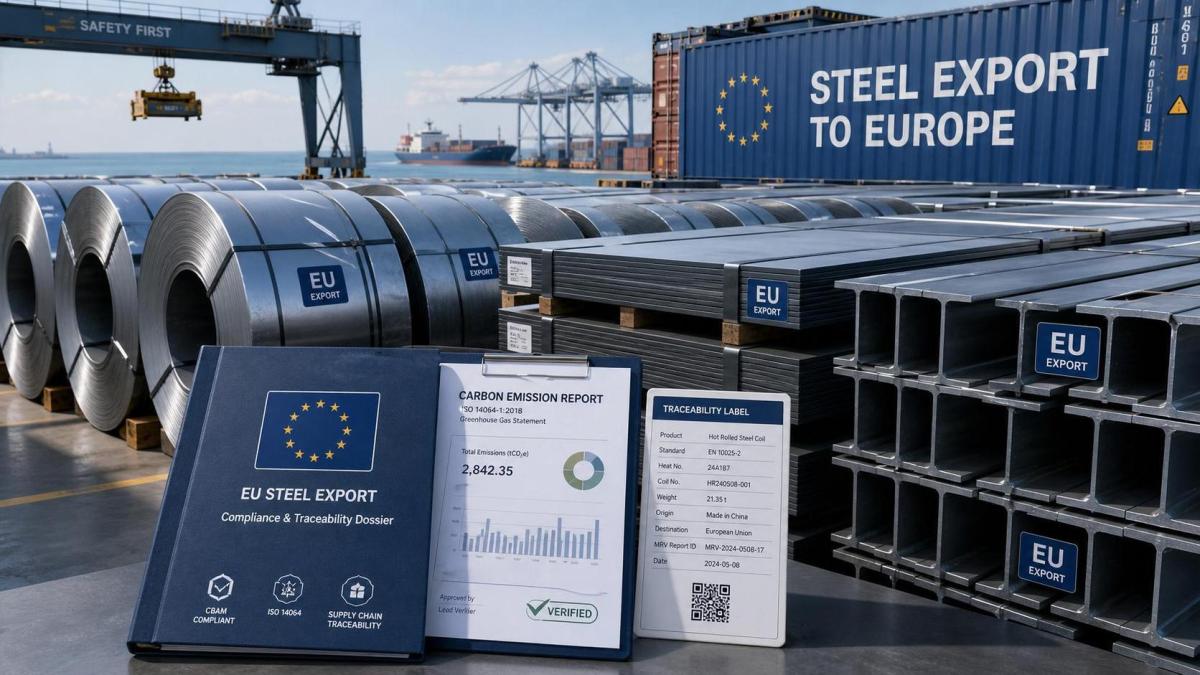
The European Commission issued updated operational guidance for the CBAM transitional period on June 20, 2026. According to the information provided, from July 1, 2026, all Chinese exporters selling steel products to the EU, including hot-rolled coil, cold-rolled sheet, galvanized sheet, and sections, must submit quarterly embedded carbon emissions data through the CBAM portal together with a third-party verification statement.
The update also newly brings the upstream iron ore procurement path into the accounting scope. Based on the event summary provided, this change has a direct connection with export quotation setting and the time needed for compliance preparation.
Where the pressure shifts across the steel export chain
Export transactions now depend more heavily on emissions documentation
For direct exporters, the main impact is not limited to customs or sales paperwork. The reporting obligation means that shipment-related business now depends more clearly on whether quarterly embedded emissions data can be prepared on time and whether a third-party verification statement can support the filing. From an operational perspective, what deserves closer attention is the alignment between commercial teams, compliance staff, and the parties preparing emissions records.
Raw material traceability becomes more relevant in procurement
For companies involved in raw material purchasing and upstream coordination, the inclusion of iron ore procurement pathways in the accounting scope may affect how sourcing records are collected and retained. Analysis shows that procurement documentation is likely to matter not only for supply management, but also for later carbon accounting support. This makes supplier data readiness and document continuity more relevant than before.
Processors and manufacturers may face tighter internal coordination
For steel processors and manufacturers supplying EU-bound products, the rule change may influence internal handoffs between production records, emissions calculation support, and external verification preparation. The issue is not simply whether a product falls within the steel categories mentioned, but whether the related production and sourcing information can be organized within the quarterly reporting rhythm.
Service providers around compliance and verification may see added demand
For verification-related service providers and supply chain support firms, the requirement for a third-party verification statement indicates a more formal compliance step in the transitional period. Observably, companies that support filing, data collection, document review, or traceability control may become more closely involved in export execution, especially where reporting preparation affects quotation timing or delivery arrangements.
What companies should watch in immediate practice
Prepare carbon data and verification files earlier
Companies shipping steel products to the EU should pay close attention to whether quarterly embedded emissions data can be assembled in a timely manner and whether supporting verification can be arranged without delaying export execution. The event information does not provide detailed procedural timelines beyond the mandatory start date, so this should be treated as a practical area requiring continued attention rather than an already settled operating pattern.
Review upstream procurement records for accounting relevance
Because the new guidance brings iron ore procurement pathways into scope, firms should pay closer attention to the completeness and consistency of upstream sourcing records connected to EU-bound steel products. Analysis shows that this may affect not only compliance review, but also how confidently exporters can support declarations tied to specific shipments or reporting periods.
Reassess quotation and lead-time assumptions
The event summary explicitly notes an effect on export pricing and compliance preparation cycles. From an industry perspective, this makes it sensible for exporters and buyers to revisit how quotations are structured and whether delivery planning needs to reflect added preparation time for data gathering and verification. This should be understood as a compliance-linked commercial issue, not only a reporting issue.
Track further clarification in execution language
The current information confirms the rule change and the mandatory start date, but it does not provide the full operational detail of every reporting scenario. What deserves closer attention is whether later official wording, customer document requests, or tender and contract language begin to reflect a stricter interpretation of reporting support, verification expectations, or sourcing traceability.
Why this looks like an execution signal rather than a distant policy theme
Analysis shows that this update is better understood as an implementation-stage signal than as a broad policy discussion. The reason is that the guidance links a clear date, a defined filing channel, a quarterly reporting obligation, and a third-party verification requirement with specific steel export activity. At the same time, observably, the inclusion of upstream iron ore procurement paths means the compliance focus is moving beyond finished product declarations and closer to supply-chain-backed accounting.
That said, it would be premature to treat every commercial effect as fully settled. It is more appropriate to understand this as a rule change that has already entered execution, while some practical interpretations and market responses still need to be observed through actual filing, customer follow-up, and industry implementation.
How the market may best read this update now
At this stage, the industry significance lies in the fact that CBAM transitional compliance for EU-bound steel exports is becoming more document-intensive and more closely tied to upstream sourcing information. For exporters, manufacturers, procurement teams, and compliance support providers, the immediate issue is readiness of data, verification, and records rather than abstract policy awareness.
A neutral reading is that this development should currently be treated as a live compliance and execution requirement with commercial consequences, especially for quotation preparation and timing control. The broader market impact still requires observation through practical enforcement, filing experience, and how counterparties incorporate the requirement into procurement and delivery processes.
Basis of this article and points that still need verification
This article is generated based on the user-provided news title, event date, and event summary. Information of this kind is commonly associated with source categories such as official announcements, regulator releases, customs or trade authority information, industry association updates, standard-related documents, and reporting by authoritative trade media.
No specific official source link was provided in the input, so the exact official link still needs to be verified on an ongoing basis. Observably, the points that continue to merit follow-up include later policy detail, the execution approach for verification and reporting, possible changes in tender or customer document requirements, market feedback from affected companies, and how enterprises adapt their reporting and sourcing workflows in practice.
NEWS NAVIGATION
CONTACT US