
NEWS

On 26 May 2026, China’s steel export licensing regime—introduced on 1 January 2026—achieved full operational maturity with the completion of its end-to-end digital upgrade and regulatory闭环 (closed-loop supervision). This policy directly affects global steel importers, procurement managers, and downstream manufacturers, particularly those engaged in trade with or sourcing from Chinese producers, due to newly enforced interlinking requirements between export authorisation, customs declarations, carbon reporting, and EU CBAM pre-submission data.
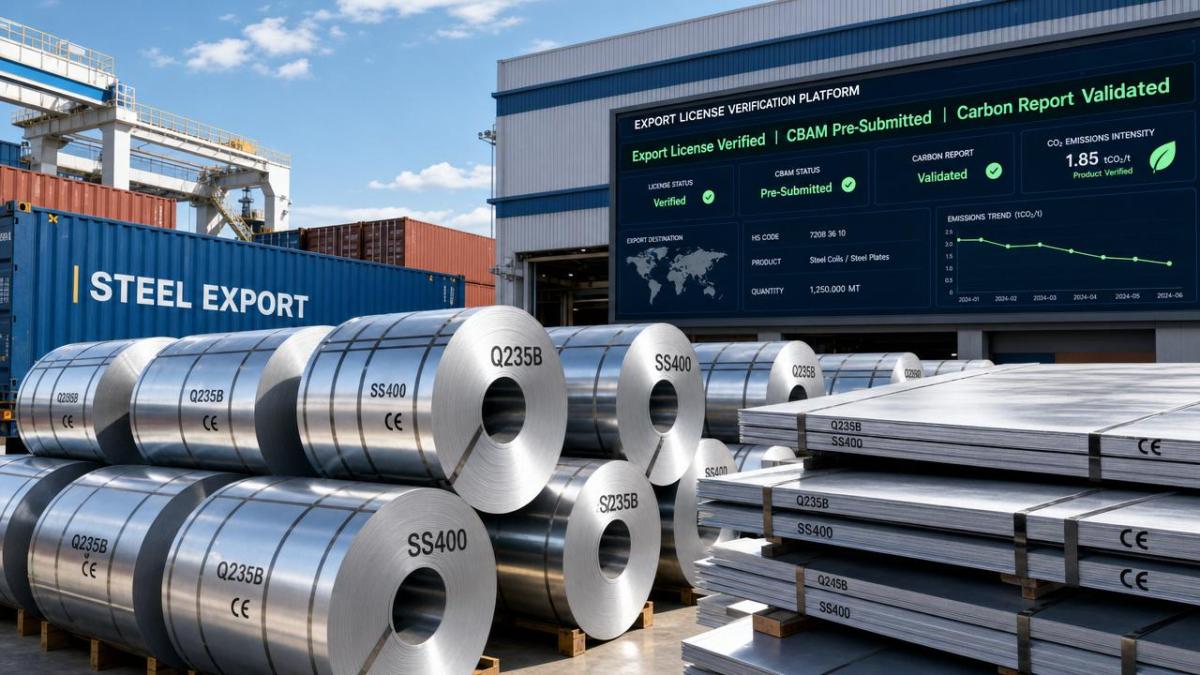
Full Implementation of the Export Licensing Framework
As of 26 May 2026, the Ministry of Commerce of China confirmed the completion of system-wide integration for the steel export licensing mechanism. All exported steel products must now be validated in real time via the official Export Qualification Verification Platform, with mandatory linkage to three data streams: customs declaration records, verified carbon emission statements, and CBAM pre-declaration information. This requirement applies uniformly to all steel exports subject to licensing under the 2026 framework.
Impact Across the Global Steel Value Chain
Direct Trading Enterprises
International traders handling Chinese steel shipments face extended customs clearance timelines if supplier credentials are unverified or misaligned on the platform. Discrepancies may trigger automatic holds at EU ports, especially where CBAM-related documentation is incomplete or inconsistent with declared origin and emissions data.
Raw Material Procurement Entities
Buyers sourcing semi-finished or raw steel inputs (e.g., slabs, billets, coils) must now validate not only mill certifications but also upstream carbon accounting transparency. The licensing platform does not accept standalone mill certificates—it requires traceable, platform-registered carbon declarations tied to each consignment.
Downstream Manufacturing Firms
Manufacturers relying on Chinese-sourced steel for EU-bound finished goods (e.g., automotive components, construction machinery) risk non-compliance with green public procurement criteria. EU buyers increasingly require proof of CBAM-aligned upstream supply chain validation—now contingent upon the exporter’s verified platform status.
Supply Chain Service Providers
Freight forwarders, customs brokers, and logistics platforms must integrate with the verification platform’s API or designated data submission interface to synchronise shipment-level documentation. Manual or batch-based reporting is no longer accepted for licensed steel categories post-26 May 2026.
Key Compliance Priorities for Importers and Suppliers
Validate Exporter Licensing Status Before Order Placement
Confirm that the Chinese supplier holds active, platform-registered export qualification—and that their licence explicitly covers the specific steel grade, form, and destination market. Unregistered or expired status results in automatic rejection of associated customs entries.
Align Carbon Reporting with CBAM Pre-Submission Requirements
Ensure the supplier’s carbon emission statement includes ISO 14067–compliant scope 1 & 2 data, product-specific emission factors, and third-party verification references accepted under EU CBAM transitional rules. Mismatches between declared emissions and CBAM pre-submission values will delay customs release.
Integrate Documentation into End-to-End Trade Processes
Link commercial invoices, packing lists, and bills of lading to the unique platform-generated verification ID for each shipment. Customs authorities now cross-check this ID against real-time platform records during electronic customs processing.
Maintain Audit-Ready Records for 36 Months
Both exporters and importers must retain platform-issued verification logs, carbon reports, and CBAM pre-submission confirmations for a minimum of 36 months—subject to potential audit by Chinese MOFCOM or EU national CBAM authorities.
Industry Perspective: Beyond Compliance, Toward Integrated Supply Chain Governance
Analysis shows this development signals a structural shift—not merely an administrative upgrade. From an industry perspective, the real-time data linkage reflects China’s alignment of domestic export controls with transnational climate accountability frameworks. What deserves closer attention is how rapidly downstream buyers (especially in the EU) are internalising platform verification as a de facto prerequisite for tender eligibility—even where not yet mandated by law. Observably, compliance is evolving from a transactional checkpoint into a continuous, digitally auditable dimension of supplier relationship management. It is more appropriate to understand this as the institutionalisation of carbon-traceable trade, rather than a temporary procedural adjustment.
Strategic Implications for Global Sourcing
This policy marks a definitive step toward embedding environmental performance metrics into core trade infrastructure. For procurement professionals, it elevates supplier due diligence from quality and delivery assurance to integrated sustainability governance. While short-term friction is expected—particularly among SMEs lacking digital reporting capacity—the long-term effect may accelerate harmonisation between Chinese export standards and EU Green Deal supply chain expectations. Rational assessment suggests that early adopters who invest in platform integration and carbon data readiness will gain measurable advantages in order acceptance, customs predictability, and downstream market access.
Source Attribution and Ongoing Monitoring
This article is based exclusively on the provided title, event date (26 May 2026), and summary description. No external data sources, policy documents, or official links were referenced. Specific official source links were not provided in the input and should be verified continuously. Stakeholders are advised to monitor forthcoming implementation guidelines from China’s Ministry of Commerce, updates to the Export Qualification Verification Platform user manual, CBAM transitional rule clarifications from the European Commission, and sector-specific feedback from industry associations such as the World Bureau of Metal Statistics (WBMS) and Eurofer.
NEWS NAVIGATION
CONTACT US