
NEWS
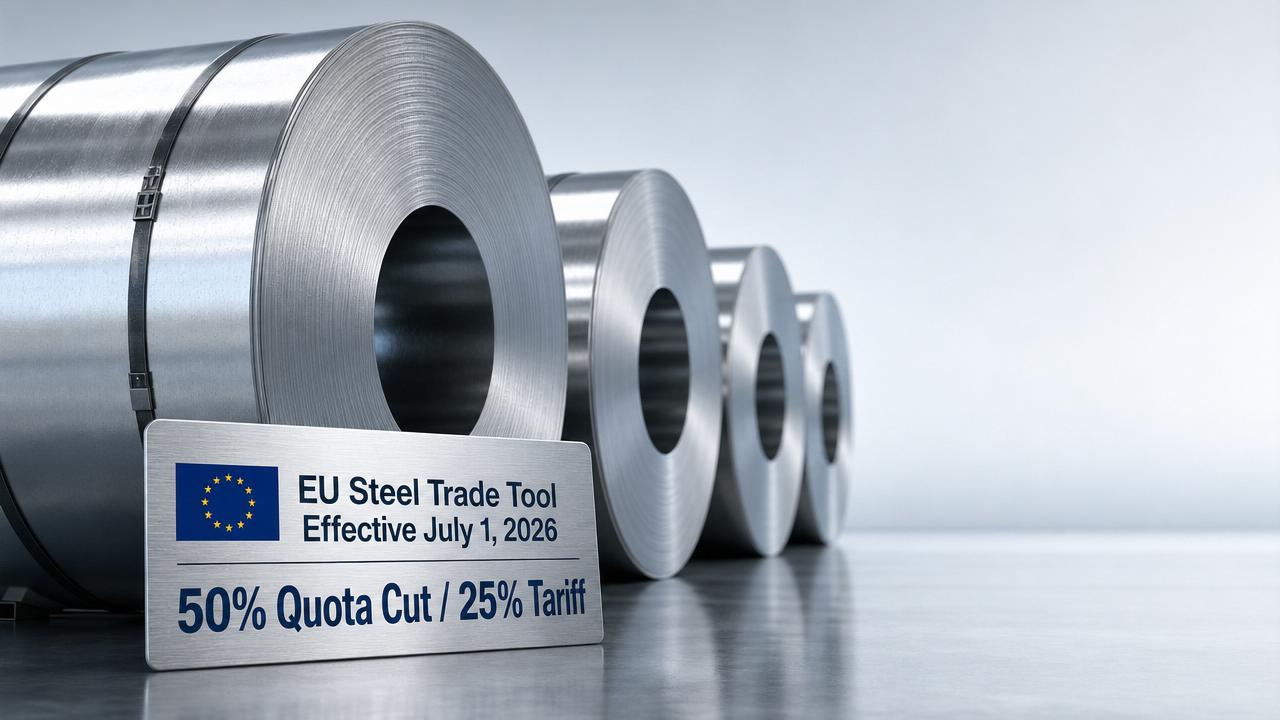
The European Commission has formally adopted new long-term steel trade defense rules, set to enter into force on 1 July 2026. These measures replace the current safeguard regime and introduce significant changes—including a 50% reduction in import quotas or a flat 25% tariff—and for the first time, a ‘melting and casting’ origin rule. Importers, distributors, and supply chain operators in steel-intensive sectors—including construction, automotive, machinery, and metal fabrication—should monitor implications closely, as the policy directly targets steel exports from non-market economies such as China and reshapes global trade flows, compliance pathways, and third-country processing models.
Event Overview
The European Commission officially adopted revised steel trade defense regulations, effective 1 July 2026. The new instrument replaces the existing steel safeguard measures. Key confirmed provisions include: (i) a 50% reduction in allocated import quotas for certain steel products, or alternatively, (ii) imposition of a uniform 25% import duty; and (iii) introduction of a new ‘melting and casting’ origin criterion to determine product eligibility for quota access. The regulation explicitly references non-market economy countries—including China—as primary policy targets.

Industries Affected
Direct Trading Enterprises
Companies engaged in cross-border steel import/export face immediate exposure to quota reallocation or tariff application. Because the new origin rule requires proof that melting and casting occurred within the exporting country, firms relying on multi-stage production across jurisdictions—e.g., billets sourced from Country A, rolled in Country B—may no longer qualify for quota access, triggering automatic application of the 25% duty.
Raw Material Procurement Entities
Buyers sourcing semi-finished steel (e.g., slabs, blooms, billets) must now verify not only final export documentation but also upstream production records. The ‘melting and casting’ requirement means procurement teams need traceable evidence of furnace operation and casting location—not just customs declarations or commercial invoices—to meet origin compliance.
Downstream Manufacturing Firms
Steel-using manufacturers—especially those with tight cost margins or long-lead procurement cycles—face higher landed costs and potential delays. If suppliers cannot demonstrate compliant origin status, imported inputs may be subject to retroactive duty assessments or customs holds, disrupting just-in-time production schedules.
Distribution & Channel Operators
Steel distributors and service centers handling blended inventories (e.g., stock from multiple origins or processing steps) will require enhanced documentation systems. Under the new rule, even consignments physically shipped from a third country may be denied quota access if the underlying melting/casting occurred elsewhere—making traditional ‘transshipment’ models materially non-compliant.
Supply Chain Service Providers
Logistics providers, customs brokers, and certification bodies must adapt verification protocols. The ‘melting and casting’ origin test demands granular technical documentation—such as furnace logs, heat numbers, and mill certificates—not routinely collected under prior regimes. Service providers lacking capacity to validate such records risk facilitating non-compliant shipments.
What Stakeholders Should Monitor and Do Now
Track official implementation guidance and product-specific annexes
The regulation’s scope—including which steel product categories fall under quota reduction versus flat-duty application—is expected to be detailed in implementing acts published closer to 1 July 2026. Stakeholders should monitor updates from the European Commission’s Directorate-General for Trade and EU Customs.
Map current supply chains against the ‘melting and casting’ origin criterion
Importers and buyers should audit supplier documentation for all steel inputs—particularly those sourced via intermediate processors—to confirm whether melting and casting occurred in the same country of export. Discrepancies may require renegotiation of sourcing terms or qualification of alternative suppliers.
Distinguish between regulatory signal and enforceable obligation
While the rule enters into force on 1 July 2026, full enforcement—including customs audits and origin verification—may be phased. However, the legal basis becomes effective immediately; preparatory compliance (e.g., document retention, supplier questionnaires) should begin well before the date.
Prepare origin documentation workflows and internal training
Procurement, logistics, and compliance teams should jointly develop standardized templates for collecting and archiving furnace-level origin evidence. Internal training on the new definition of ‘origin’—distinct from standard ‘country of export’ or ‘country of final assembly’—is recommended ahead of implementation.
Editorial Perspective / Industry Observation
Observably, this measure represents a structural shift—not merely an extension of prior safeguards. Its explicit linkage to production-stage origin (melting and casting), rather than final shipment or value-add, signals a move toward controlling upstream industrial capacity flows, especially from non-market economies. Analysis shows the tool functions less as a short-term trade remedy and more as a long-term industrial policy lever. From an industry perspective, it is better understood as a signal of increasing regulatory granularity in global metals trade—one requiring proactive documentation governance, not just tariff budgeting. Continuous monitoring remains essential, as delegated acts and customs practice will determine real-world impact intensity.
These developments underscore how trade instruments are evolving beyond volume-based controls toward process-based compliance. For stakeholders, the immediate priority is not speculation about enforcement pace, but verification readiness: whether origin data exists, where it resides, and how reliably it can be aggregated and certified.
Conclusion
This regulation marks a material tightening of EU steel market access conditions—not through blanket bans, but via layered technical criteria and financial thresholds. It does not eliminate trade, but redefines what qualifies as compliant trade. Current understanding should focus on its function as a procedural gatekeeper: success hinges less on lobbying or timing, and more on demonstrable traceability of core metallurgical processes. A measured, documentation-first response remains the most pragmatic path forward.
Source Attribution
Main source: Official Regulation adopted by the European Commission (publication reference pending; confirmed effective date: 1 July 2026).
Areas under ongoing observation: Final list of covered steel products, detailed methodology for ‘melting and casting’ verification, and phased enforcement timeline per EU Customs guidance.
NEWS NAVIGATION
CONTACT US