
NEWS
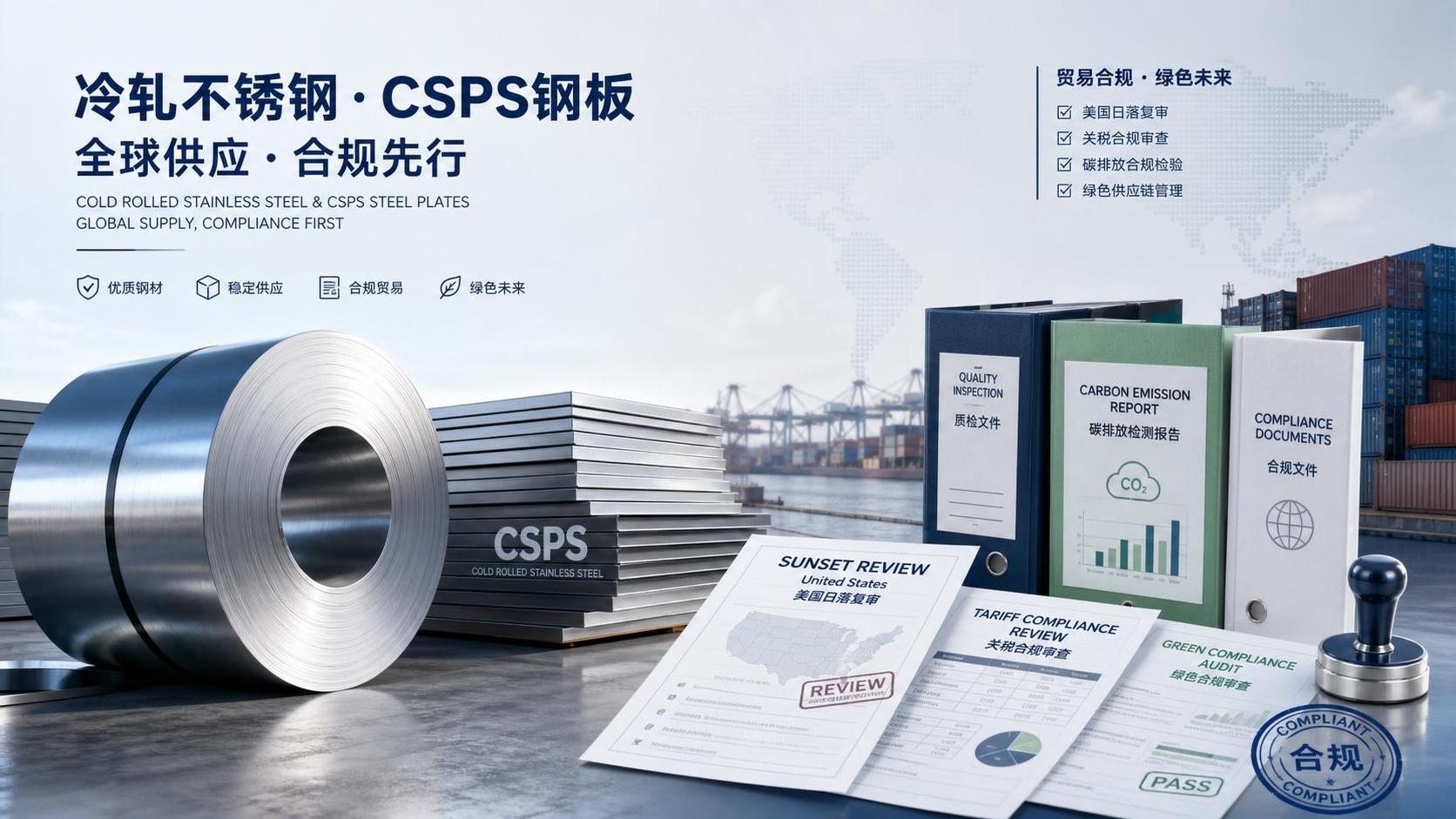
On July 19, 2026, the U.S. Department of Commerce announced a sunset review of the antidumping and countervailing duty orders on cold-rolled stainless steel plate in sheets (CSPS) from China. For exporters, U.S.-bound buyers, and supply-chain participants linked to this product flow, the development matters not only because it reopens the question of whether the duties should remain in place, but also because the review newly introduces carbon-intensity and upstream power-mix disclosure as part of a green-compliance assessment, adding a fresh layer to trade and delivery planning.
What the Official Notice Confirms
The confirmed facts are limited but commercially significant. The U.S. Department of Commerce formally initiated, on July 19, 2026, a sunset review covering antidumping and countervailing duty orders on Chinese-origin CSPS. The review will assess whether continued duties are still warranted. The notice also, for the first time in this review context, requires responding companies to submit data on carbon emissions intensity and the structure of their upstream electricity supply. According to the provided information, this directly affects delivery stability for Chinese exporters to the U.S., the preparation cycle for certifications and supporting documentation, and the reassessment of potential tariff-related costs.
Where the Pressure May Appear Across the Chain
Export-facing suppliers may face a wider compliance burden
From an industry perspective, Chinese exporters are the first group likely to feel the impact because the review now extends beyond pricing and subsidy issues into carbon-related disclosure. The immediate business pressure may appear in document preparation, internal data collection, and coordination across production and energy records. What deserves closer attention is whether companies can align trade-response materials with the new green-compliance expectations within existing shipment and customer-approval timelines.
Buyers and procurement teams may revisit delivery assumptions
For import-side buyers and procurement teams linked to U.S. delivery, the issue is not only tariff exposure but also shipment predictability. If responding suppliers need more time to prepare carbon-intensity and power-source information, procurement planning may need to account for longer confirmation cycles, more documentation review, and possible adjustments in sourcing discussions. Observably, the review raises the importance of checking whether current supplier files are sufficient for continued transaction support.
Supply-chain service providers may see more documentation-sensitive workflows
Logistics coordinators, trade service providers, and related intermediaries may also be affected because the review could increase the amount of compliance-related communication attached to cross-border orders. The practical impact may show up in scheduling, customs-facing document readiness, and customer communication around delivery certainty. What deserves closer attention is the gap between commercial booking plans and the time required to complete supporting compliance materials.
Downstream users may need to watch cost recalculation rather than assume immediate change
For manufacturers or end users purchasing CSPS-linked material for U.S.-related business, the review creates a reason to revisit cost assumptions. Analysis shows the immediate issue is not a confirmed outcome on duties, but the need to reassess exposure if tariff treatment remains unchanged or if compliance preparation adds cost and time. This is especially relevant for businesses that rely on stable landed-cost estimates for purchasing and fulfillment decisions.
Operational Priorities Worth Watching Now
Track official wording, not just the headline
The launch of a sunset review is a procedural step with commercial consequences, but it is not itself the final duty outcome. Companies should pay close attention to how official requirements are described in subsequent materials, especially where carbon-intensity and upstream electricity structure disclosures are concerned. The difference between a policy signal and an enforceable documentation expectation will matter in day-to-day execution.
Check whether supplier records can support green-compliance requests
Because the review newly asks for carbon-emissions intensity and upstream power-mix data, companies involved in the trade should focus on whether upstream records, production-related evidence, and supporting statements can be assembled in a usable form. This is a practical issue for supplier qualification, document consistency, and communication with counterparties.
Reassess timing in contracts, delivery plans, and customer communication
The provided information indicates possible effects on delivery stability and certification preparation cycles. In practice, that means businesses may need to review whether current lead times, document cutoffs, and customer-facing commitments leave enough room for review-related compliance work. Procurement and sales teams should be alert to timing risk rather than treat this solely as a tariff issue.
Separate confirmed facts from commercial scenario planning
It is also important to distinguish what is known from what still needs observation. The confirmed facts are the launch of the review, the scope involving Chinese CSPS, the reassessment of continued duties, and the addition of certain green-compliance data requirements. Any assumptions about final duty treatment, customer shifts, or long-term sourcing changes remain matters for scenario planning, not established fact.
Why This Looks Like More Than a Routine Trade Step
Analysis shows this development should be read in two layers. In the short term, it is a live trade-compliance event that can affect documentation readiness, shipment planning, and cost reviews for companies tied to Chinese CSPS exports to the U.S. In a broader sense, the newly required carbon-intensity and upstream electricity data suggest that environmental disclosure is becoming more closely linked to trade-review processes. It is more appropriate to understand this as both an immediate operational issue and a longer-term signal that compliance expectations may be widening, while still recognizing that the final outcome of the review is not yet established.
How the Industry Should Read the Current Stage
At this stage, the most balanced reading is that the announcement is neither a purely procedural footnote nor a concluded market result. It signals that companies exposed to Chinese CSPS trade with the U.S. should prepare for more complex review participation and more careful cost and delivery assessment. The industry significance lies in the combination of duty review and green-compliance disclosure. For now, it is more appropriate to understand this as an active development that requires continued monitoring rather than a settled change in market conditions.
Basis of This Article and What Still Needs Verification
This article is based on the user-provided news title, event date, and event summary. For this type of development, commonly relevant source categories may include official government notices, company disclosures, industry association updates, authoritative media reports, and standards-related documentation. The specific official source link was not provided in the input, so further verification remains necessary. Continued attention should focus on any additional official wording, procedural updates, and any clarified expectations around carbon-intensity and upstream electricity-structure submissions.
NEWS NAVIGATION
CONTACT US