
NEWS

China’s customs authority will require a more detailed export declaration framework for key steel products from August 1, 2026, turning product classification and supporting documentation into immediate trade compliance issues rather than routine filing steps. For exporters, overseas importers, procurement teams, customs brokers, and supply chain service providers, the update is worth close attention because it links HS code selection, material documentation, carbon-related disclosure where applicable, and destination-side compliance statements to customs clearance timing, cost control, and market access.
A narrower declaration framework now applies to major steel exports
According to the information provided, the General Administration of Customs of China issued an announcement on July 26, 2026 regarding adjustments to export declaration elements and HS code subheadings for certain steel products. The measure takes effect on August 1, 2026.
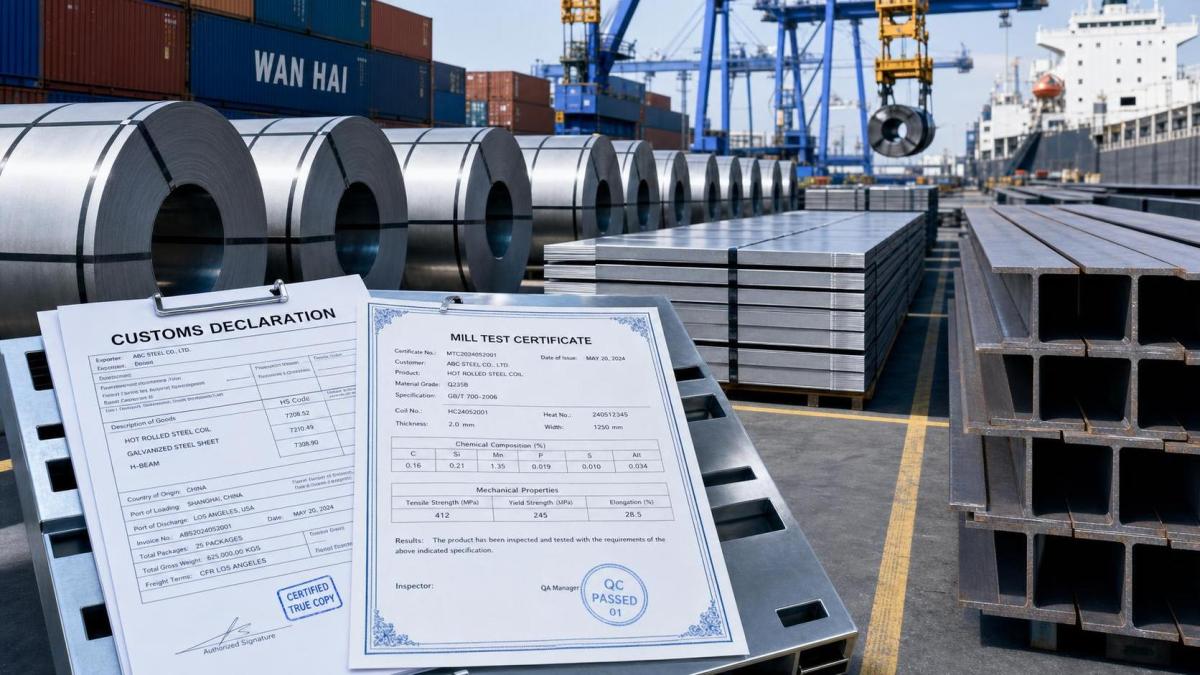
The announced change covers 12 major export steel product categories, including hot-rolled coil, cold-rolled coil, galvanized sheet, and H-shaped steel. The update introduces refined HS code management for these products and adds six new 6-digit subheadings.
The same notice also requires the submission of material certificates, carbon footprint declarations where applicable, and compliance declarations for the export destination. The provided summary states that the adjustment directly affects overseas importers’ customs clearance efficiency, compliance costs, and supply chain access qualifications.
Where the operational pressure is likely to appear first
Export filing is becoming more documentation-dependent
From an industry perspective, exporters are likely to feel the change first because the new requirement is not limited to tariff classification. It also adds document coordination around material proof, carbon footprint disclosure when applicable, and destination compliance statements. That means classification, internal product data, and outbound paperwork will need to align more closely at the shipment stage.
Import-side clearance may become more sensitive to coding accuracy
For overseas importers and their customs handling partners, the practical issue is not only whether goods are shipped on time, but whether the declared product category and accompanying documents are consistent enough to support clearance. Analysis shows that any mismatch between the updated subheading and the supporting file set could create timing pressure in customs processing, even where the goods themselves are unchanged.
Procurement and supply chain teams may need earlier document checks
For procurement functions and supply chain service providers, the rule change matters because document readiness now has a more direct connection to shipment release and downstream delivery planning. What deserves closer attention is whether suppliers can provide material certificates in a form that matches the declared goods, and whether carbon footprint and destination compliance statements are prepared when the transaction requires them.
Processing and channel businesses may face tighter traceability expectations
Processors, distributors, and other channel participants may also be affected where they sit between manufacturing and export declaration. Observably, once HS subheadings become more granular, product traceability, specification consistency, and handover records between trading parties become more important in supporting the final export filing package.
Practical points companies should review before shipments move
Check whether product mapping to the new subheadings is current
Analysis shows that one immediate task is to review whether covered steel products have been correctly mapped to the refined HS coding structure before the August 1 effective date. This is especially relevant for companies handling hot-rolled coil, cold-rolled coil, galvanized sheet, H-shaped steel, and other products within the 12-category scope described in the provided information.
Reconfirm the completeness of supporting files
Companies should also pay close attention to the supporting file set now referenced in the announcement: material certificates, carbon footprint declarations where applicable, and compliance declarations for the export destination. Since the input does not provide detailed execution rules, it is more appropriate to understand this as a requirement to verify document completeness and internal responsibility allocation rather than assume a single standard filing format is already settled.
Watch for changes in delivery planning and buyer coordination
For commercial teams, another point to monitor is whether buyers, logistics coordinators, and customs service providers need updated product descriptions or pre-shipment compliance checks. From an industry perspective, even a short implementation window can affect delivery sequencing if product coding and supporting statements are finalized late in the process.
Follow later wording and enforcement practice closely
What deserves closer attention is the execution approach that may emerge after the effective date, including how the new declaration elements are applied in practice and whether market participants adjust technical files, bidding documents, or supplier qualification materials in response. The information provided confirms the rule change itself, but does not set out fuller operating guidance.
This looks like an execution signal, but not the final word on practice
Analysis shows that this development is better understood as an implemented compliance change with immediate operational effect, not merely a policy discussion point. The effective date is explicit, the covered product groups are identified, and the additional declaration materials are named. At the same time, observably, the market still needs to watch how filing practice, documentation thresholds, and cross-border coordination settle once companies begin applying the new subheadings in live transactions.
How the market should read this development now
At this stage, the update is best read as a concrete tightening of export declaration requirements for major steel products, with direct implications for classification discipline, documentation control, and shipment readiness. It should not be overstated as a full reordering of steel trade conditions, but it does indicate that coding precision and supporting compliance records are becoming more central to export execution and importer clearance outcomes.
Basis of this article and what still needs verification
This article is generated from the user-provided news title, event date, and event summary. For events of this kind, relevant source categories typically include official announcements, releases from regulatory authorities, customs or trade administration information, industry association notices, standards-related documents, and reporting by authoritative media.
No direct official source link was provided in the input, so the exact source document link still needs to be verified on an ongoing basis. Further observation is also needed on implementation details, interpretation in actual declaration practice, possible adjustments in compliance documentation, changes in bidding or procurement files, market feedback, and how companies execute the new requirements after the effective date.
NEWS NAVIGATION
CONTACT US