
NEWS
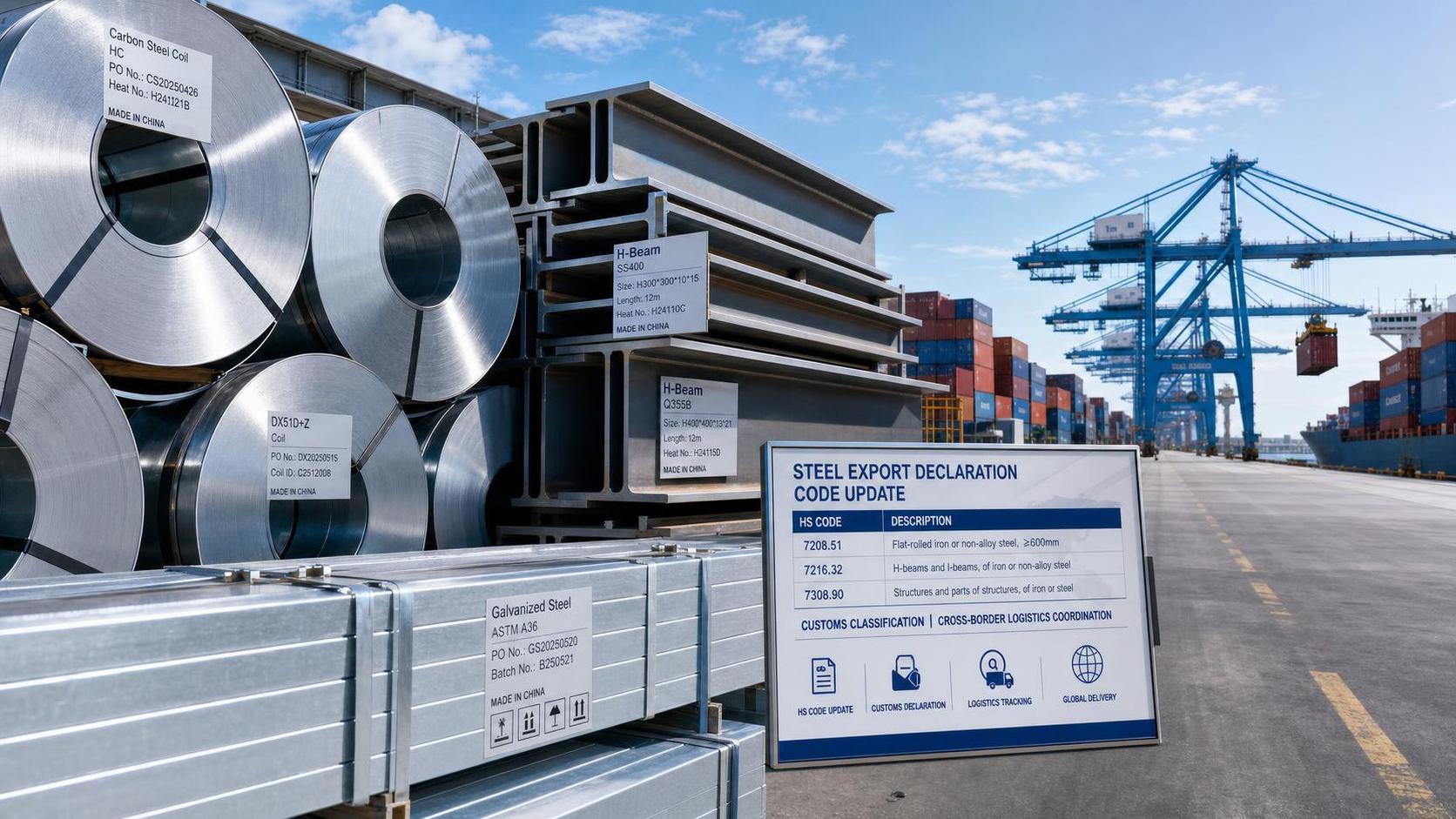
China's General Administration of Customs began mandatory use of a refined export declaration coding rule for steel products on August 1, 2026, requiring exporters to report shipments under more specific HS subheading codes. The change matters not only to steel exporters, but also to overseas importers, customs brokers, procurement teams, and supply chain operators because declaration accuracy now has a more direct bearing on customs clearance timing, origin-related compliance review, and ERP data alignment across cross-border transactions.
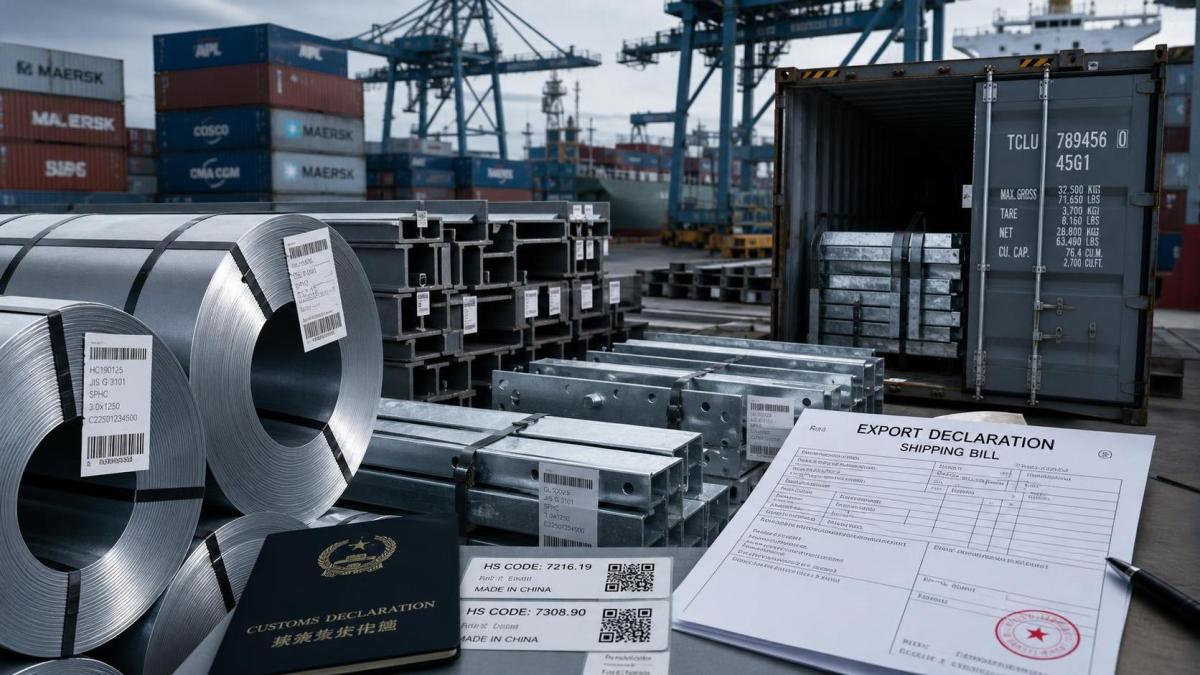
A more granular declaration requirement is now in force
According to the confirmed information provided, China's General Administration of Customs formally activated the Detailed Rules for Steel Product Export Declaration Codes (2026 Edition) on August 1, 2026. The new rule adds 37 HS subheading-level codes and applies to major export categories including hot-rolled coil, cold-rolled stainless steel plate, H-beams, and galvanized structural components.
The same information states that all export customs declarations must now use the new codes with precise classification. It also confirms that incorrect declaration may lead to port detention, rejected filings, or inclusion on a priority inspection list. In addition, the change is described as having a direct effect on overseas import customs clearance efficiency, origin-related compliance determination, and ERP system data integration.
Where the operational pressure is likely to appear first
Export filing and shipment release
From an industry perspective, exporters are the first group exposed to the rule change because the declaration itself is now the control point. The operational impact is likely to show up in product classification, customs document preparation, and shipment release timing. What deserves closer attention is whether internal product descriptions, specification sheets, and declaration language are detailed enough to support the new code selection for affected steel categories.
Overseas import clearance and document consistency
Overseas importers and their customs service providers may feel the impact when import-side records need to align with export-side declarations. Analysis shows that the practical issue is not only code usage at the point of export, but also document consistency across invoices, packing lists, origin-related materials, and import clearance submissions. Where a code is too broad, outdated, or mismatched with the product description, clearance timing may become less predictable.
Procurement and supply chain data handoff
Procurement teams, trading companies, and supply chain service providers may be affected through system and process coordination rather than through filing alone. The event summary specifically points to ERP data integration, which suggests that product master data, SKU mapping, and order-to-shipment workflows deserve attention. Observably, any mismatch between commercial documentation and declaration coding could create avoidable friction in delivery scheduling and document exchange.
Compliance and origin-related review
Compliance personnel and documentation teams should also treat this as a relevant change because the summary links the new coding regime to origin-related compliance determination. Analysis shows that the rule may matter wherever exporters rely on product classification consistency to support origin statements, customer documentation requests, or trade-facing compliance reviews. The immediate issue is not the creation of a new certification regime, but the need for more accurate alignment between declared product identity and supporting records.
What companies should review now
Recheck code mapping for affected steel lines
It is more appropriate to understand this as an immediate classification and documentation task for companies handling hot-rolled coil, cold-rolled stainless steel plate, H-beams, galvanized structural components, and other covered steel products. Businesses should review whether existing internal product mapping still matches the finer HS subheading structure now required for export declaration.
Align documents used across trade and compliance workflows
Analysis shows that firms should pay close attention to consistency among customs declarations, commercial documents, technical product descriptions, and origin-related materials. If these records are maintained by different teams or systems, the main risk is not abstract regulatory change but inconsistent information traveling through the transaction chain.
Check ERP and data interface readiness
Because the provided summary specifically identifies ERP system data alignment as an affected area, companies should focus on whether their internal coding tables, interface fields, and master data structures can handle the new declaration granularity. No confirmed implementation detail beyond that has been provided, so this should be treated as a practical review point rather than as proof of a uniform market-wide outcome.
Watch for execution signals in daily filings
What deserves closer attention is how strictly the new coding requirement is reflected in daily customs filing practice, document rejection patterns, and inspection exposure for misdeclared shipments. The provided information already confirms that incorrect declaration can trigger detention, filing rejection, or priority inspection, so companies should monitor operational feedback closely as filings proceed under the mandatory rule.
Why this looks more like implementation than early policy signaling
Observably, this development is better understood as a landed compliance change rather than a distant policy direction, because the rule is already in force and tied to mandatory export declaration behavior from August 1, 2026. At the same time, analysis shows that the market still needs to observe how consistently the finer coding requirement is interpreted in practice across affected product groups, documentation scenarios, and cross-border system workflows.
It is also more appropriate to view this as an execution signal for trade compliance and supply chain coordination, not merely as a customs classification update. The direct link to clearance timing, origin-related review, and ERP handoff means the change reaches beyond customs desks into procurement, logistics, and customer-facing delivery management.
A rule change with immediate operational consequences
In practical terms, the August 1 rollout of refined steel export declaration codes signals a stricter expectation for classification accuracy in outbound steel trade. The confirmed facts support a cautious conclusion: this is already an effective compliance requirement, and its significance lies in how it may affect filing accuracy, document consistency, system connectivity, and shipment execution. Current market participants would be better served by treating it as an implemented rule with continuing execution implications rather than as a background policy update.
Basis of this article and what still needs verification
This article is based on the user-provided news title, event date, and event summary. For developments of this kind, relevant source types typically include official notices, releases from regulatory authorities, customs or trade administration information, industry association updates, standard-setting documents, and reporting by authoritative media.
No specific official source link was provided in the input, so the exact official publication path still requires follow-up verification. Further observation is also needed regarding detailed implementation language, compliance interpretation in practice, document requirements used in transactions, possible changes in tender or procurement documents, industry feedback, and how companies are adapting their execution processes after the rule takes effect.
NEWS NAVIGATION
CONTACT US