
NEWS

China's customs authority began applying a revised compliance guide for steel export declarations on July 22, 2026, introducing more detailed HS code classification rules for 12 mainstream steel product categories and linking those declarations more closely with certificates of origin. For exporters, overseas importers, customs teams, and supply chain service providers, this matters because declaration accuracy now carries more immediate consequences for clearance efficiency, certificate-related risk, and ERP data alignment, especially in transactions involving buyers in the EU, Southeast Asia, and the Middle East.
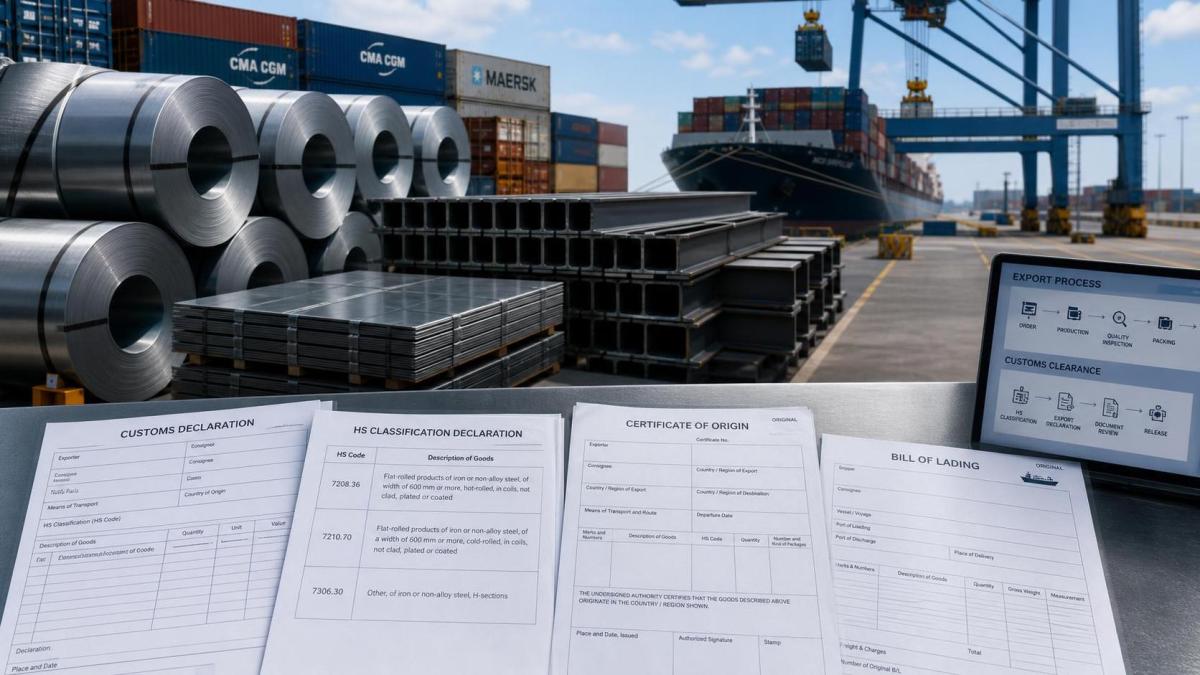
What the revised filing guide formally changes
According to the information provided, the General Administration of Customs of China officially implemented the Compliance Guide for Export Declarations of Steel Products (2026 Revised Edition) from 00:00 on July 22, 2026. The adjustment sets out more granular HS code classification rules for 12 major steel product groups, including hot-rolled coil, cold-rolled sheet, and H-beams. It also clarifies the associated requirements between HS classification and certificates of origin in the export declaration process.
The same information indicates that the change directly affects customs clearance efficiency for overseas importers, the risk of certificate return or rejection, and ERP system data connectivity. It also raises the required level of declaration accuracy for importers handling steel shipments into the EU, Southeast Asia, and the Middle East.
Where the pressure is likely to appear first
Export declaration and documentation workflows
Exporting companies are likely to feel the impact first because HS coding sits at the center of customs declaration, document preparation, and coordination with overseas buyers. Analysis shows that when classification rules become more detailed, the practical pressure usually falls on internal product mapping, invoice and packing list consistency, and the matching logic between declared goods and origin-related documents. What deserves closer attention is whether existing filing practices for hot-rolled coil, cold-rolled sheet, H-beams, and other covered products still align with the newly defined classification granularity.
Import-side clearance coordination
Overseas importers may be affected through customs clearance timing and document acceptance. From an industry perspective, the issue is not only whether goods can be declared, but whether the export-side HS classification and origin documentation can be used smoothly on the import side without triggering re-checks, return requests, or mismatches in local filing systems. This is particularly relevant where buyers are already working under tighter declaration scrutiny.
ERP and master data management
Supply chain service providers, customs support teams, and companies running integrated trade systems may face an operational burden in ERP mapping and master data maintenance. Observably, a refined HS classification framework can expose gaps between product descriptions, internal SKU structures, and declaration fields. Where origin-related information is tied more directly to classification, data consistency across sales orders, shipping documents, and customs entries becomes a more immediate compliance issue rather than a back-office formatting matter.
Procurement and delivery coordination
Buyers and trading intermediaries may also need to revisit order confirmation and delivery preparation. Analysis shows that if declaration precision becomes more important, procurement teams may need clearer product specifications earlier in the transaction, especially for steel categories that can be close in commercial description but treated differently in filing logic. That can affect pre-shipment document review, handover timing, and communication between suppliers, freight partners, and import-side brokers.
What companies should review now
Check product-to-HS mapping for covered steel categories
Companies handling the 12 mainstream steel categories should review whether current product naming, technical description, and declaration mapping are still adequate under the revised guide. Since the input does not provide line-by-line implementation criteria, it would be premature to assume how every product variant will be treated in practice. The immediate focus should be on whether internal classification logic is documented clearly enough to support consistent filing.
Reconcile origin documents with declaration data
Because the revised guide connects HS classification more explicitly with certificates of origin, exporters and their service partners should pay closer attention to document consistency. Analysis shows that mismatches between declared product identity and origin-related records may become more visible under a stricter filing framework, with potential effects on certificate handling and importer-side processing.
Test ERP fields and interface logic
For companies using ERP or trade management systems, one practical task is to review whether item master data, customs declaration fields, and document outputs remain synchronized. What deserves closer attention is not only the HS code field itself, but also whether downstream forms, templates, and interfaces carry the same product logic across commercial, logistics, and customs workflows.
Watch market-specific filing sensitivity
The provided information specifically highlights higher accuracy requirements for importers in the EU, Southeast Asia, and the Middle East. Observably, exporters serving these markets should monitor whether customers, brokers, or local compliance teams begin requesting tighter supporting documentation, clearer item descriptions, or earlier confirmation of declaration details. Since no further execution guidance is provided in the input, this remains an area to track rather than a settled outcome.
Why this looks like an execution signal, not just a notice
Analysis shows that this update is more appropriately understood as a rule now in force rather than a policy direction still waiting for implementation. The effective time is explicit, and the content described goes beyond a general statement by addressing product-level HS classification and the relationship with certificates of origin. At the same time, it would be too strong to claim that market impact is already uniform across all steel export transactions. Observably, the next layer of industry attention should focus on how filing practice, system alignment, and document review standards are applied in day-to-day operations.
How the market should read this change
At this stage, the adjustment is best read as a compliance and execution development in steel export administration rather than a broad market forecast. Its significance lies in the way a customs declaration rule can move into procurement preparation, document control, importer coordination, and system management. From an industry perspective, the most rational conclusion is that companies involved in covered steel categories should treat declaration accuracy and origin-document consistency as near-term operational priorities while continuing to observe how implementation practice develops.
Basis of this article and what still needs verification
This article is based on the user-provided news title, event date, and event summary. For developments of this kind, relevant source types typically include official notices, releases from regulatory authorities, customs or trade administration information, industry association updates, standard-setting documents, and reporting from authoritative media. A specific official source link was not provided in the input, so that link still needs to be verified on an ongoing basis.
Further observation is also needed on any subsequent implementation details, compliance interpretation, tender or document wording changes, industry feedback, and how companies adjust their declaration and data-handling practice after the revised guide takes effect.
NEWS NAVIGATION
CONTACT US